
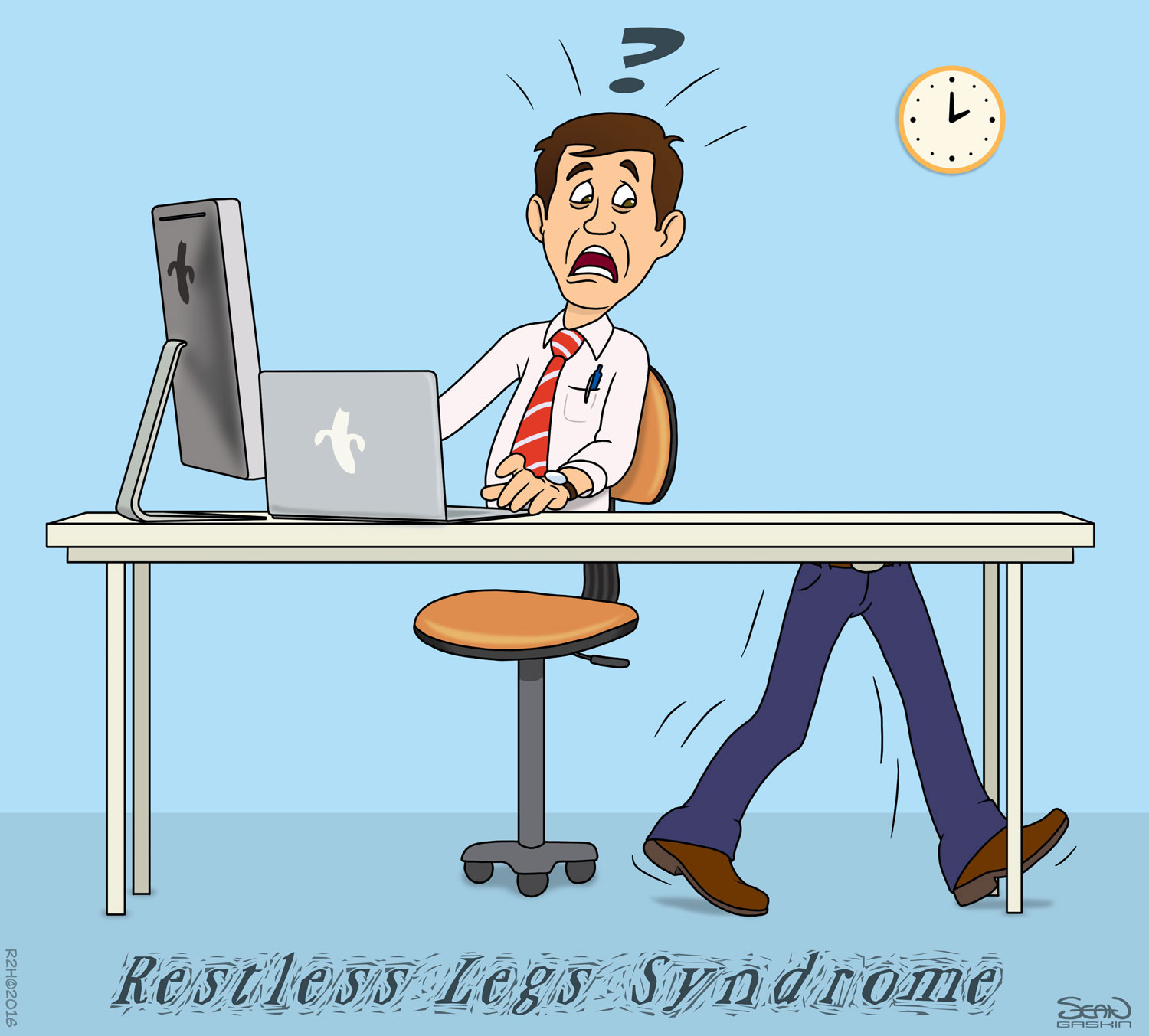
Restless legs – (RLS) -A higher risk for cardiovascular events in women: By Dr. De Leon

Happy 2018 to all my friends and followers- hope everyone is staying healthy and keeping a positive outlook for the new year.

This year I would like for you to join me in actively pursuing a lifestyle which will help us live better, happier, and healthier. This begins by recognizing what problems we have and actively finding solutions. For instance, my biggest challenge this year will be to mange my sleep deprivation better (more on this soon) trying new treatments to get my sleep wake cycle into a more normal state.

Now that I am almost done getting the house back in order after the holidays, I thought it was time to address a common problem found in nearly 50% of PD patients; as well as other parkinsonian syndromes such as MSA known as restless leg syndrome (RLS). This is a nervous system disorder that causes an urge to move the legs (arms, or other body parts) usually one limb at a time. This an extremely uncomfortable sensation in which only way to temporarily relief the urge is to move the limb or walk. These feelings are described as having ‘pins and needles‘  ‘creepy crawly sensation‘ as well as an ‘itching sensation‘ which occurs mostly at rest sitting or lying down. Because it occurs frequently at night it causes severe disruption of sleep – believe me it is nearly impossible to fall asleep when legs feel like they wont stand still although no involuntary movements present just an intense sensation of discomfort and need to move and walk about; hence it is also classified as a sleep disorder.

I have mentioned in the past that RLS is not only a symptom of the disease but can be a n initial problem even years before other motor symptoms developed. Plus, it also is a risk factor for developing PD. We may recall that RLS can be a familial disease and a secondary problem such as in PD but also as part of  iron deficiency, neuropathy, diabetes, kidney failure, and pregnancy (extremely frequent in third trimester). when i experience these symptoms is because my neupro patch has fallen off or i re-injured my back and is causing me radiculopathy- both of which i treat immediately.

But, until recently we were not aware that having RLS was a contributor of  cardiovascular events at a greater rate in women compared to men according to a robust study of  nearly 58,000 women from Nurse’s Heath study.

Rls affects about 10% of the population. but is more commonly seen in women than men. Perhaps this fact is skewing results and causing disparity in mortality rates. Nevertheless, we cannot ignore these new findings because as you know, I along with many others have been discussing for a while now the fact that there are great differences in PD presentation according to gender. I have also said that women are at higher risk for strokes and heart attacks from PD. Now we have another factor commonly seen in many PD patients which if not properly treated can accelerate the risk to death from one of these events. Although further research is needed into this area. it could be that not just women with RLS may be at higher risk  for strokes and heart attacks but more importantly those of us women with PD may also be at a much higher risk.

The theory behind the cause for this disparity is attributed to the autonomic and dopamine dysfunction particularly sympathetic stimulation which raises blood pressure.

In order to decrease risk of cardiovascular events, first we must diagnose and treat the problem.

RLS is diagnosed clinically.

Triggers for RLS:

certain medications can worsen symptoms

  • anti-nausea medications like phenergan, compazine ( same one that will worsen PD symptoms
  • cold and allergy medicines – dextrometomorphan
  • alcohol
  • sleep deprivation
  • withdrawal from neupro patch
  • caffeine

RLS treatments:

  • According to recent AAN Guidelines for treatment of RLS- first treatment should include mirapex ( in my professional experience as well as per guidelines this works much better than requip), Neupro patch (rotigotine) and Horizant (gabapentin enacarbil).
  • DBS may be the next thing in treating RLS; so far in a small study of 22 patients researchers have shown sustained relief /improvement of symptoms 2 years after surgery.
  • 24 hour infusion of duopa also has been shown to relieve symptoms

However, we still have to be cautious about new treatments on the horizon and over the counter/home remedies as a significant reliable treatment because there appears to be a greater than usual placebo effect. 48 out of 68 studied patients with rls showed marked improvement in sleep and quality of life on placebo although the daytime sleepiness  worsened.

So the moral of the story, there appears to be increase risk of mortality in women with RLS which may translate to the same risk or even higher in women with PD. Hence important to be treated – best by adjusting PD medicines in my experience and ruling out secondary causes if symptoms worsen or persist. Ok to try massages and other alternative treatments like leg pumps, soap bars in socks or mattress but if sleepiness is not improved than sure sign that root of problem is not being targeted and can still lead to increase mortality. Any questions concerns especially if already have history of risk factors for stroke like obesity, high blood pressure, diabetes, or smoking need to discuss treatment plan with PCP/neurologists asap.

lets us all do our best to be proactive in our health this year!

copyright @2018

all rights reserved by Maria De Leon MD

Sources:

http://www.medscape.com/viewarticle/890643 (women at higher risk of cv)

http://www.medscape.com/viewarticle/872681 (aan guidelines)

http://www.medscape.com/viewarticle/847146 (Dbs surgery)

http://www.medscape.com/viewarticle/865307 (dopa infusion)

http://www.medscape.com/viewarticle/865627 (placebo effect)

3 Tips to Making the Most of the New Year: By Maria De Leon

via 3 Tips to Making the Most of the New Year: By Maria De Leon

3 Tips to Making the Most of the New Year: By Maria De Leon

As we stand on the brink of a new year, is only human to want to find comfort in the past. However, we must remember that life is a constant cycle of seasons. If we want to be happy, we must learn to embrace the changes having PD brings into our lives such as a new found creativity. One must first learn to let go of things that hold us back like anger, trepidation, and fear in order to move forward. The New Year is our opportunity to shine and try new things like new therapies, treatments, and even renew our strength by making peace with our illness.

We now have 365 new pages to rewrite our history with PD. Will we throw in the towel or will we unveil victory? It is all up to us.

 Tips to a great 2018.

Be good to yourself. No matter how you feel inside be present in the moment. Always acknowledge your feelings. Don’t try to ignore them, hide from them, or give in to them. You are no good to anyone if you are over run with emotions. The best way to keep emotions in check is getting a good sleep even if you go to bed till 3 a.m. as I often do. Rearrange your schedule, ask loved ones not to disturb you, disconnect your electronic devices, turn off phone, get dark curtains, and tell yourself this is your time. Prioritize yourself. I have found that if I allow myself to sleep, I feel almost normal and can tackle things much more efficiently and effectively.10432937_753295454728183_4275273717487230047_n(art by Ross Webb)toriaband

Make time for what makes you happy. Allow yourself time to pursue new and old dreams making reasonable short and long term goals. This means spending time helping others by being a mentor, a shoulder to lean on, a caregiver, and an advocate. Always wanted to paint, write, play an instrument, change careers, travel, learn a new language, or simply spend more time with family and friends? Be bold and try doing it this year. I have decided to go back to an old passion of mine- singing. When I began having dysphonia (vocal cord dystonia), I was saddened and gave up doing something that I loved. Although, I no longer can reach high notes, I have discovered a range I never thought possible. This is sure to make life interesting and perhaps even improve my hypohonia by strengthening my oral-pharyngeal muscles.

Find a way to move and stay active. It’s a lot easier to exercise routinely when you have a friend by your side. The best way to maintain an exercise routine is finding something you love and can fit your physical needs. Whether it be tango dancing, swimming, boxing, or bicycle riding, all of these activities are sure to not only improve your physical and emotional disposition. But, don’t neglect your brains need to be exercised as well. By participating in social gatherings and learning new things as I mentioned above you will improve your cognitive status. I love doing all sorts of puzzles. Find things to challenge you even if it’s eating with your eyes closed to discover the texture of foods or taking a different path on your drive home or customary walk. 2017 MJFF DC-292_zpsumbzibpd

Self- love is the underlying message which can only be achieved by boldly embracing our weaknesses and highlighting our strengths, helping others and being kind to others, and opening ourselves to new possibilities. Never forgetting to always smile and be thankful for the little things.

Happy New Year 2018!

xoxo

Parkinson’s Diva

copyright @2017

all rights reserved by Maria De Leon MD


Nasal Congestion: The Cold or PD? By Maria De Leon

via Nasal Congestion: The Cold or PD? By Maria De Leon

Nasal Congestion: The Cold or PD? By Maria De Leon

251343312-medical-cold-flu-red_nose-runny_nose-family_trait-mfln6435_low

It has been a while since i written here but i could not let the year finish without me saying one last note and thanking all of you for being part of my PD journey this year. i hope We all get to a new healthy start…

At least in this side of the world, we are just commencing the cold season in which many of us may unfortunately develop a cold.  As you know having a cold is fraught with nasal congestion, stuffiness, runny nose among scratchy sore throat and other symptoms.

But after having a viral infection that wiped me out for more than two months and caused severe upper respiratory problems, I began to notice that sometimes the stuffiness did not respond to common decongestants rather improved with me taking my levodopa.

So, I thought i would address this issue which some of you might have experienced or are continuing to experience these nuances wondering why symptoms are persistent or coming and going more frequently? Just as I seem to wake up more congested in am when my medicine levels are lower and quickly clears after am doses kick in.

First, let me say that rhinorhea- ‘runny nose’ has been found to be much more common in PD patients believed to be up to 5x more common in people with PD not related to allergies or other contributing causes. this is believed to be a non-dopaminergic ( non-motor) symptom.  although, still not very well recognized or studied and even less commonly talked about is actual nasal congestion- which I believe is dopaminergic mediated and appears as the levels of dopamine are weaning off. This why i believe many patients including myself have a thick nasal mucus pooling in the back of the throat which makes it difficult to swallow. this is not related to post nasal drip, allergies or infection.

The former symptom of  runny nose can be extremely bothersome just the same causing frequent post nasal drip;  for those who have already difficulty swallowing it can be even more trouble some causing chemical pneumonia, and frequent cough, or choking episodes. Because there is natural increased salivation with eating many might feel the need to avoid social meals. However, for increased salivation (sialorrhea) Botox is the best treatment in my personal experience because has no systemic side effects and effect last  3- 6 months.

There are many treatments for this problem with primary use of anticholinergics as a first line. I often used Levsin -(hyoscyamine). This pharmaceutical drug comes in liquid, pill and injection form which is extremely convenient.  I prescribed frequently to my patients to reduce secretions. Although, it is an anticholinergic  and can potentially cause confusion at small doses I did not experience this. However, if someone has dementia or hallucinating , this drug probably would not be best option. Another anticholinergic is one applied via a nasal spray (Atrovent- commonly used for bronchitis, copd) recently studied in a very small trial with good effects.

Of Note: Apokyne (apomorphine) has runny nose as a common side effect.

But, on the other hand nasal congestion is even less talked about. this does not respond to decongestants, antihistamines very well. It only improves with intake of dopamine medications. There is  absence of literature on this subject. The only thing I found upon doing a literature search was a great deal of patient forums mentioning this problem and a small report on 26 PD in which authors concluded that “women over 60 were more likely to have this problem“.

However, if we look at pregnancy where levels of  dopamine decrease and other hormonal changes like elevated levels of prolactin exist there is a tendency for women to develop nasal congestion which resolves after pregnancy.  Interestingly, enough is during pregnancy that some women may fist develop signs of pd or have worsening of symptoms. Hence at least on the surface a tangible connection between low dopamine levels and increased nasal congestion. The nasal congestion is caused by excess blood circulation swelling the tiny vessels of the nasal mucosa leading to a stuffy nose feeling. Plus, remember that dopamine is a vasoconstrictor meaning they cause the blood vessels to decrease in diameter. But, if there is not enough dopamine circulating then vessels will dilate which really have same effect as blood rushing in widening tiny vessels causing a sensation of fullness and stuffiness.

If you have watery itchy eyes, sore throat, chills, fever, or increased sneezing then these are signs you are NOT dealing with nasal congestion from lack of dopamine/Parkinson’s.

You should seek medical attention especially if symptoms last beyond a week.

If you are told by your physician that there is no cause for your congestion as infections, allergies, and other irritants have been  ruled out talk to your neurologist/MDS about adjusting your medications. but first pay close attention when this occurs, keeping a diary and also if there are other motor symptoms involved like increased stiffness, tremors and so on during this time make sit a lot easier to associate as pd being the culprit. Now, before i take any decongestants i make sure i take my medications which always resolves my congestion unless I have other symptoms.

In the meantime, here are a few home remedies you may want to try for your congestion.

  • Use Humidifiers – but don’t forget to rinse with soap and water periodically to avoid mold and other bacteria from growing.
  • Inhale steam or add some Vick’s vapor rub to hot boiling water and breath in.
  • Use saline drops or saline gel (found in baby isle at stores)
  • Stay hydrated- drink more fluid than usual during the cold season
  • Use petroleum jelly or Vick’s vapor rub gently applying a very tiny dose in nasal passage a couple of times a day.
  • Take Vitamin C
  • Drink ginger tea- this not only helps with inflammation of mucosa but also stomach inflammation and helps nausea and increases digestion.

Happy Holidays everyone!

Many blessings and well wishes to all and hope to continue this journey with your support in the upcoming year!

Sources:

http://n.neurology.org/content/70/6/487

https://www.ehealthme.com/cs/parkinson-s-disease/nasal-congestion/

http://www.medscape.com/viewarticle/827413

@copyright 2017

All Rights reserved by Maria De Leon,MD

finding the right assisted living for your loved one with PD_ Dr. De Leon

Assisted Living for Parkinson’s Disease

A Year in the Parkinson’s Diva Life: By Maria De Leon

via A Year in the Parkinson’s Diva Life: By Maria De Leon

3 Tips to Making the Most of the Holidays: By Maria De Leon

via 3 Tips to Making the Most of the Holidays: By Maria De Leon

Announcing publishing of Viviendo mas alla del parkinson: explorando las posibilidades (Living beyond Parkinson: exploring the possibilities) by Dr. De Leon

La enfermedad del párkinson afecta todo nuestro ser desde lo profundo e invisible hasta lo visible y superficial, aunque el efecto es diferente para cada individuo. A pesar de no parecernos físicamente, todos tenemos una cosa en común—el querer vivir una vida mejor, llena de éxito, felicidad, y amor; en si una, vida abundante. Queremos aprender a caminar con la enfermedad al lado pero no controlados por ella.

Por lo tanto los Viviendo más allá del párkinson: explorando las posibilidades están basados en la experiencia profesional y personal de una doctora especialista de la misma. Su propia experiencia que abarca más de dos décadas cubre todos los aspectos de la vida desde ser madre, esposa, cuidadora, doctora y paciente. Por lo siguiente nos reta a vivir con las manos abiertas haciéndole frente al párkinson día tras día hasta encontrar el balance que nos de la paz interna y las fuerzas para continuar luchando por nuestros sueños, y pasiones descubriendo las cosas bellas que aún tiene la vida para nosotros.

No solo la Dra. María De León cubre los puntos básicos sobre la enfermedad y como tratarlos, pero también habla sobre la importancia de la investigación especialmente en el área de la genética. Los últimos puntos son de mayor importancia para el desarrollo del conocimiento de la enfermedad en el pueblo latino. Por lo tanto habla de las barreras que existen en el tratamiento de los hispanos y como romper las para tener éxito. En fin nos alienta al saber que no estamos solos como latinos en esta lucha. Pero solo por medio de la oración y la fe, la educación (sobre nuestra enfermedad) junto con los medicamentos adecuados, seguir físicamente y mentalmente activos podremos lograr alcanzar la meta (una vida abundante).


Translation

Parkinson’s disease affects all side from the deepest to the superficial and from the invisible to the seen, although each individual manifest the disease differently. Despite the differences we all have one thing in common –wanting to live a better life filled with love, joy, and success – in other words an abundant life despite PD. So this book is based in the professional and personal experience of a doctor tuned patient in her own specialty. Her vast experience of more than two decades covers all aspects of being a wife, mother, doctor, patient and caregiver. Subsequently, she challenges us to face Parkinson’s with open arms day by day until you can find the balance between living with a progressive illness and still having a full life.

In this book Dr. De Leon covers the basic questions regarding diagnosis, treatment, progression, alternative medicines, diet, new theories and current research. She challenges everyone to become involved by first becoming a self-advocate and moving to participating in research trials especially in the area of genetics with large PD. She also addresses the barriers that contribute to health disparity in Latinos in general as well as in women. She gives us hope and tips to finding balance dealing with individual troublesome symptoms of disease from diet to sleep problems. But we cannot achieve well being isolated but rather need to work with others (including patients, healthcare professionals, and law makers) and find time for personal inter and intra development through various venues like exercise, meditation, and art therapy.

book is available at present in kindle form- amazon.com, amazon.ES,

thewordverve.com/shop/Viviendo más allá del párkinson: explorando las posibilidades

la proxima semana sera imprimido (next week will be published in print)

thank you all for making this a reality

gracias a migos por su apoyo y por hacer este sueno realidad.

os quiero

maria

@copyright 2017

all rights reserved by Maria De Leon